
What a production-based availability contract does not cover
Production-based availability contracts cover less than many owners assume. Here is what typically falls outside the guarantee.
It is a common misconception that, under production-based availability contracts, the O&M provider is taking all the production risk.
The key word is availability.
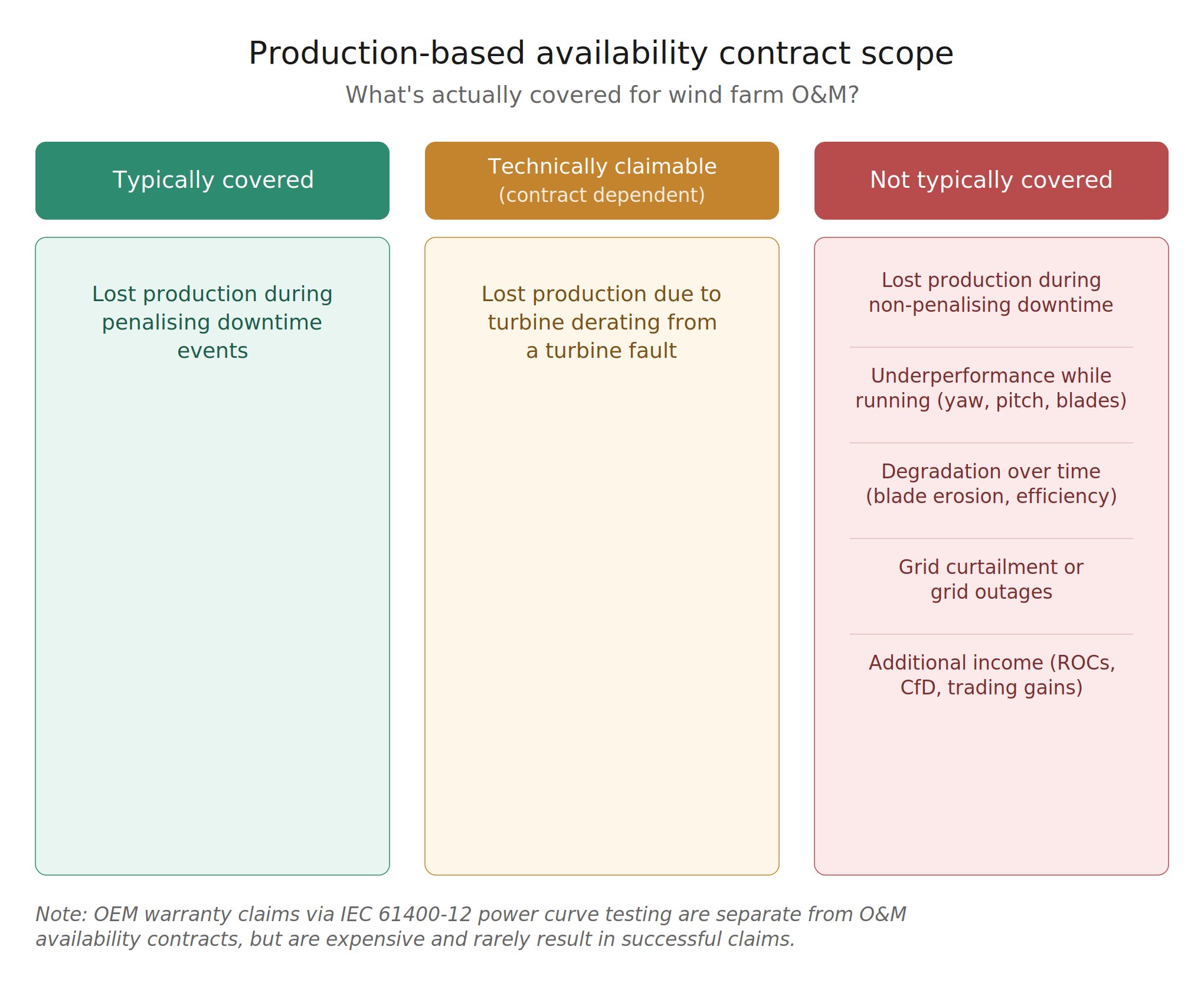
For many of these contracts, compensation is mainly linked to penalising downtime events when the turbine is not available. Because typical contractual availability guarantees are in the mid-90s, production claims are usually limited to a relatively narrow subset of losses. Losses while the turbine is running and fully available are often not covered.
That includes underperformance, such as yaw misalignment, pitch issues, blade erosion and control faults. These issues can reduce production without compensation, and the O&M provider often has limited financial incentive to identify or resolve them.
Derating is another grey area. Some contracts do allow claims for fault related derating, but only if the contract explicitly provides for it and the operator can systematically detect, quantify and evidence the loss. Most operators do not have the tools or processes in place for these claims.
There is a related point on OEM guarantees. Owners sometimes assume OEM performance guarantees cover underperformance. But making a claim requires an IEC 61400-12 power curve test, which is expensive, time consuming and difficult to prove conclusively in practice.
The bottom line
Production-based availability contracts do not transfer all performance risk to the O&M contractor. Independent monitoring still matters, because many sources of production loss are not covered.
Charts and analysis by PowerVeritas. Where open datasets are used, sources are credited on the attributions page.