
Services / S/02PowerVeritas Ltd

Wind Farm Technical Due Diligence

PowerVeritas provides independent technical due diligence for operational wind farms, built from turbine level SCADA rather than from the seller’s reporting.

Go into an acquisition, a refinancing or the end of warranty knowing exactly what technical risk you are taking on. Scope matched to commercial need.

Core scope & optional modules

Every TDD starts with the same three core workstreams. Optional modules are selected to match the commercial question, because a refinancing, an acquisition and a life extension decision each need different emphasis.

Core scope
  • 01Production history & loss attributionReconstruction of site production, with losses quantified by cause across wind, availability, curtailment and underperformance.
  • 02Data quality & reconciliationCompleteness, consistency, reliability and cross-check of available SCADA and metered data.
  • 03Risk registerEngineering risks surfaced through the engineering scope performed (core reviews plus any optional modules selected), ranked and described for investor use.
Optional modules
  • M01Power curve health checkPer turbine performance assessment identifying underperformance, faults and sensor issues that warrant engineering follow up. The same method as a standalone wind farm performance review, scoped to the transaction question rather than to a recovery plan.
  • M02Operational energy yield assessmentUpdated P50 and P90 built from the site's operating history rather than the pre construction assessment.
  • M03Design envelope complianceSite specific wind conditions vs. design basis, for life extension or uprate cases. Indicative check; not a load assessment.
  • M04Component health & reliabilitySite level review of component condition and failure rate trends, using SCADA and operational data.
  • M05O&M contract technical reviewEngineering assessment of O&M contract terms, performance guarantees and technical risk allocation, highlighting clauses that affect asset value or operational flexibility. Complements legal review. Informed by experience monitoring a large renewables fleet.

What you receive

Deliverable A

Executive TDD report

Engineering assessment covering core workstreams and any optional modules commissioned. Executive summary, findings by workstream, ranked risk register and supporting charts. Written for board, lender and investment committee audiences.

Deliverable B

Diagnostic evidence pack

Detailed analytical findings with supporting charts, data tables and methodology notes. Written for the buyer's technical team and any third party reviewers.

Deliverable C

Data export

Underlying analytical outputs including production reconciliation and loss attribution data, plus module specific outputs where applicable. Provided in Excel for integration with the buyer's own analysis.
Sample analytical output

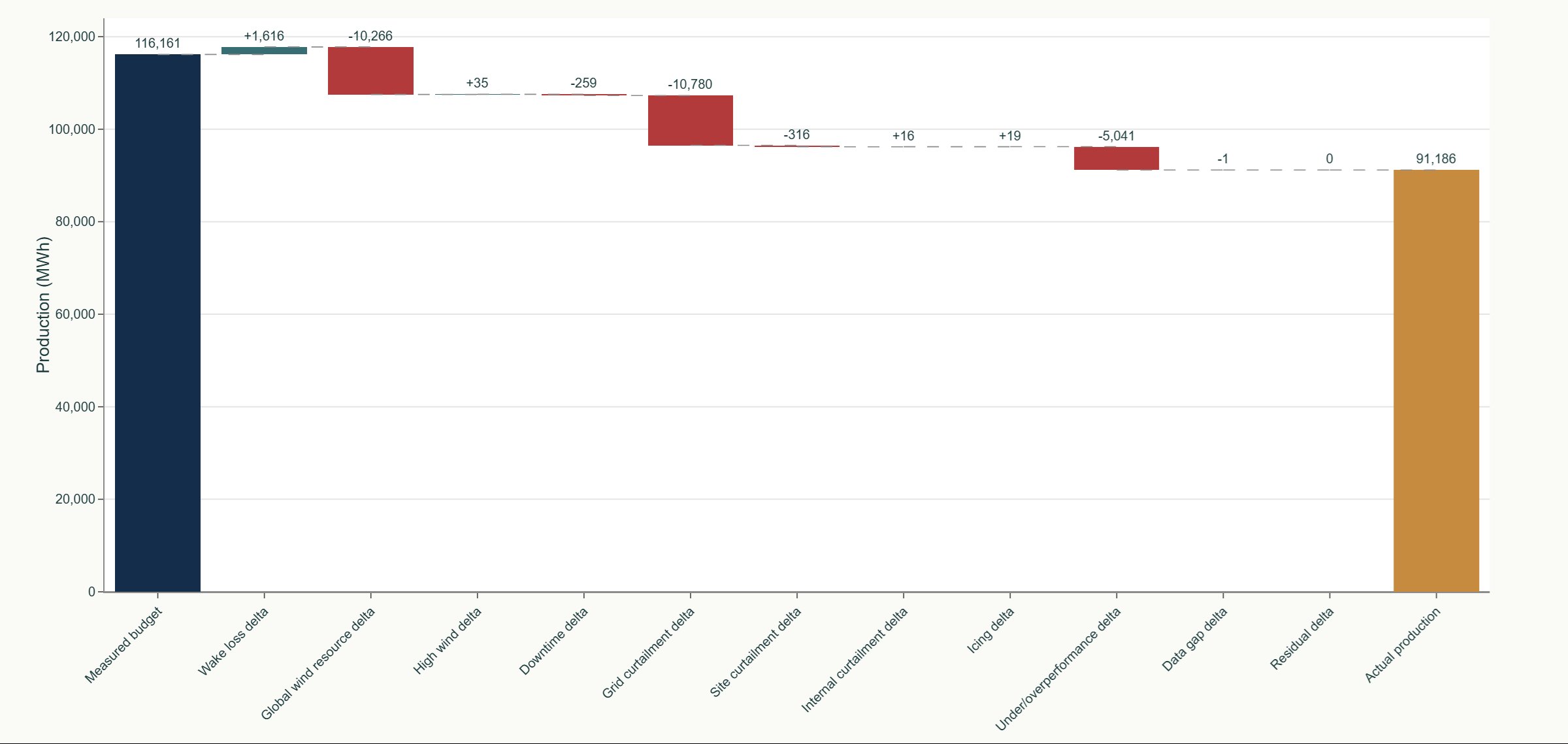
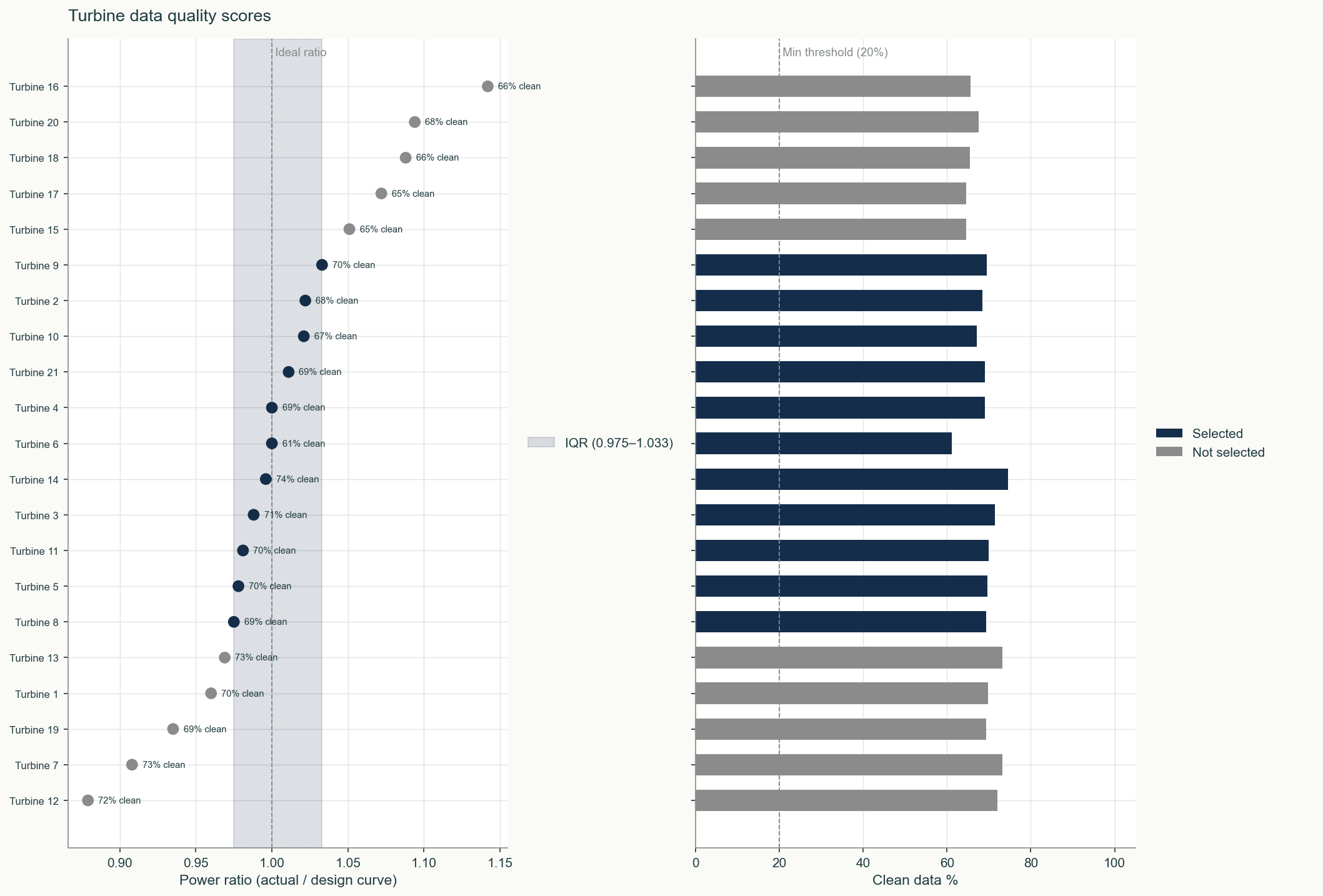
TDD findings only stand up if the underlying analysis can be inspected. The two illustrative figures below are from a real site, showing how site production is reconstructed and reconciled to actuals with each loss quantified by cause, and how turbine selection for analysis is supported by a transparent data quality view, so reviewers can see what was included and why.

Step 01 / Production history & loss attribution
Loss attribution waterfall, one operating month
Waterfall chart reconciling site production for one operating month. From a measured budget, deltas for wake loss, global wind resource, high wind, downtime, grid curtailment, site curtailment, internal curtailment, icing, under or overperformance, data gap and residual losses lead down to actual production.
Budgeted production is reconciled to actual through wind, atmospheric, downtime and curtailment effects. Each step is quantified in MWh so the largest drivers are visible at a glance and the residual is explicit, not buried.
Step 02 / Data quality & reconciliation
Per turbine data quality & reference turbine selection
Two panel chart. The left panel shows each turbine's power ratio (actual divided by design curve) with the interquartile range highlighted; right panel shows the percentage of clean data per turbine with a minimum threshold line at twenty percent. Selected turbines are highlighted in dark navy.
Turbines are scored on power ratio (actual vs design curve) and proportion of clean data. Outliers and low data units are flagged before any cohort analysis, and the selection used downstream is shown explicitly so reviewers can see what was included and why.

Common questions

When should an owner commission a Technical Due Diligence?

Technical Due Diligence is appropriate for any decision requiring defensible independent technical verification of a wind asset. The most common triggers are acquisitions and refinancing. TDD is equally valuable at end of warranty, when considering life extension or repowering, during major contract renegotiation and ahead of insurance renewal. Scope is modular and matched to the commercial question.

Why do I need a technical review of my O&M contract?

A technical review brings data and engineering depth that a legal or commercial review cannot. It examines how availability, lost production and performance guarantees are actually calculated and whether the methodology unnecessarily advantages the O&M contractor. It also draws on operational experience of where contracts have failed in practice, often with considerable financial implications. The review provides factual engineering input alongside any commercial or legal review, particularly valuable at renewal, re-tender, dispute, or end of warranty.

How long does a technical due diligence take?

Typically between one week and a month from receipt of the data room, depending on the modules commissioned. Transaction timetables are usually workable if the deadline is known at proposal stage. Give the date it is needed by and the scope can be shaped around it.

What data do you need for a due diligence?

Turbine level SCADA at ten minute resolution for the operating period and site metered output where available, plus the O&M contract if the contract review module is included. Availability and downtime records, alarm logs and any commissioning or warranty documentation strengthen the assessment. Where the data room is thin, the report says what that limits.

Can you rebuild a P50 and P90 for a site that is already operating?

Yes. An operational reforecast uses the site's own production history reconciled against long term wind records, rather than a pre construction yield assessment carried forward. That usually matters most at refinancing, where the original P50 was set before a single turbine turned.

What if the seller will not release raw SCADA?

For a UK site registered in the Balancing Mechanism, quite a lot is still possible. Metered output and curtailment volumes are published through Elexon, so actual production and curtailed energy can be reconstructed without anything from the seller, then checked against a P50 and P90 estimate built from long term wind records and the site configuration. That is a coarser answer than a SCADA based reconstruction and the report says so, but it does not depend on the seller. Outside the UK, or where a site is not in the Balancing Mechanism, scope depends on what other data is available.

Is the report suitable for a lender or an investment committee?

It is written for that audience. The executive report carries a ranked risk register and findings by workstream, with the diagnostic evidence pack behind it for technical reviewers.

How does this differ from a due diligence by a large consultancy?

Scale, proportion and speed. Large consultancies bring breadth and are sized for large transactions, with the day rates and lead times that follow. PowerVeritas brings a Chartered Engineer who reviews every output personally, on scope matched to the commercial question, and can usually be more nimble on delivery times than a larger consultancy. Depth in SCADA analytics rather than breadth across every discipline.

Can the scope be adjusted to what I actually need?

Yes. Every technical due diligence is quoted against the scope required rather than sold as a package, so workstreams that do not bear on your decision can be left out. A refinancing, an acquisition and a life extension case each need different emphasis. Each module is also available on its own as a standalone piece of work.

Want to review a site or portfolio?